Tomoko Woods tends to her vegetables and flowers with the precision of a craftswoman and the heart of a storyteller. Her journey from the cities and countryside of Japan to the rich soils of northern Tasmania has been one of quiet transformation, shaped by family legacy, curiosity and a devotion to living lightly on the land.
Tomoko was a young woman when her father made a radical choice that would alter the course of their lives. At 48, he walked away from a well-paid job in the city to become an organic farmer. “He wanted to quit his well paying job, go to the countryside and have a block of land to grow vegetables,” she says. “Maybe not so much chasing a money type vision.” At a time when few in Japan were embracing such ideals, the move was both brave and unconventional. He grew vegetables, wrote books, appeared on radio and welcomed city dwellers seeking a different life into their rural home.
Letter to the Editor
These early experiences left a deep impression on Tomoko. “Seeing them growing vegetables, happy life in the countryside and with the fresh vegetables, it tastes so much better,” she says. “It just slowly takes over the pallet.” When she moved to Australia and eventually settled with her husband, Trevor, she carried that ethos with her.
In South Australia, she started small, experimenting with growing food on a sand dune block, where success required patience and resilience. Over time, her garden expanded, shaped by permaculture principles and a no-dig approach supported by roaming chickens that fertilise and aerate the soil. “Every six months the chickens come back and do it again,” she says.
The North Coast Post: BSB 633 000 · Account number: 2366 8 9535
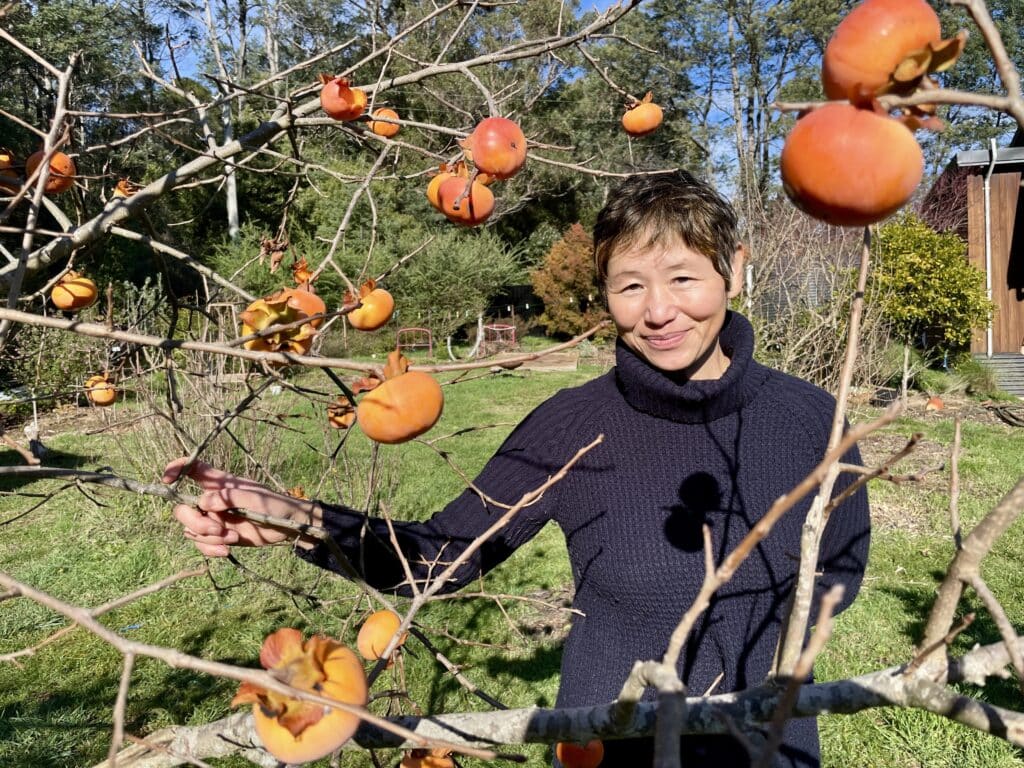
But it was the move to Tasmania that gave her the space and climate to fully realise her vision. “Elizabeth Town. Beautiful soil, lots of water. So it’s just a perfect spot,” she says. On their new property, Tomoko grows a wide variety of vegetables such as Japanese white turnips, daikon radishes and shiso herbs, along with vibrant seasonal flowers. “Freshness beats everything else,” she says.
What began as a personal passion soon became a community venture. During the COVID lockdowns, Tomoko immersed herself in flower farming. A borrowed book from the library inspired her to begin growing dozens of varieties from seed. “Propagation is my passion and obsession,” she says. Her arrangements now grace local cafés and hair salons. She even runs workshops, helping others learn how to transform backyard flower patches into mini-farms.
Tomoko also channels her skills into Japanese cooking classes held in their home, combining her garden produce with a philosophy of minimal intervention and seasonal freshness. “[I’m] encouraging people to grow vegetables as well. And eat healthy and live happily ever after,” she says.
Her classes, which book out quickly, are a reflection of her warm, open nature. “Quite a few people were interested to start,” she says. “They come, I share. It’s very casual. That’s the good thing about it.” Attendees enjoy a garden tour, hands-on demonstrations and a meal that captures the essence of her lifestyle. She keeps prices low and the experience personal, with a maximum of nine attendees. “I only have nine good plates,” she says with a laugh.
Even with the cooking, farming and flower arranging, Tomoko finds time to give back. Last year, she hosted a fundraiser for the Asylum Seeker Resource Centre, raising $1,000 by offering meals prepared from her garden. “People come, eat my food, and put the money in the tin,” she says.
Her life, while full of work, is grounded in purpose. “It’s good for me to be busy, to do something,” she says. “It’s not just about making things. It’s about sharing.”
Trevor Woods has spent his life building things. Not just in the traditional sense, though he began as an electrical fitter and mechanic and later became a technical officer overseeing major telecommunications projects. More profoundly, he has built a philosophy rooted in a practical commitment to sustainability.
Born to migrant parents who arrived in Australia for weapons research work, Trevor’s early years were marked by movement and adaptation. “My father worked at Weapons Research, but he ended up working for the Americans on the Firestone Rockets,” he says. “He was on the base that put the first Australian satellite up.” The family lived in Woomera, deep in the South Australian desert, before returning to Adelaide.
At 18, Trevor joined the PMG’s department as an apprentice and soon found himself on a post-cyclone mission through the Northern Territory, inspecting and repairing telephone exchanges from Alice Springs to Darwin. “It was pretty crazy when I think about it. Like an 18-year-old in charge,” he says. The experience launched a career in communications that spanned decades, eventually transitioning to Telecom and later Australia Post.
It was at Australia Post that Trevor found his most fulfilling role. As a technical training officer, he helped usher in new waves of automation and sorting technology, travelling to Sydney, Melbourne and the United States for training. “It was the best job I ever had in my life,” he says. “I was involved in everything new.” That included learning to operate German and Japanese sorting machines and translating that knowledge into training programs for local technicians.
Yet throughout his professional life, Trevor remained deeply interested in energy and how to use it better. His first major revelation came after installing a solar hot water system in an Adelaide home in the late 1970s. “My bill just dropped away to nothing,” he says. “It was like a light bulb moment. A feeling of freedom.”
This realisation grew into a broader commitment to renewable energy. Over the years, he insulated homes, oriented living spaces to maximise solar gain, and installed rooftop panels long before they became commonplace. “We were the first in the street to put solar panels on our house,” he says of one early installation. The government’s rebate and feed-in tariff at the time made the investment not just environmentally wise, but financially sound. “We were making money on a one kilowatt system,” he says.
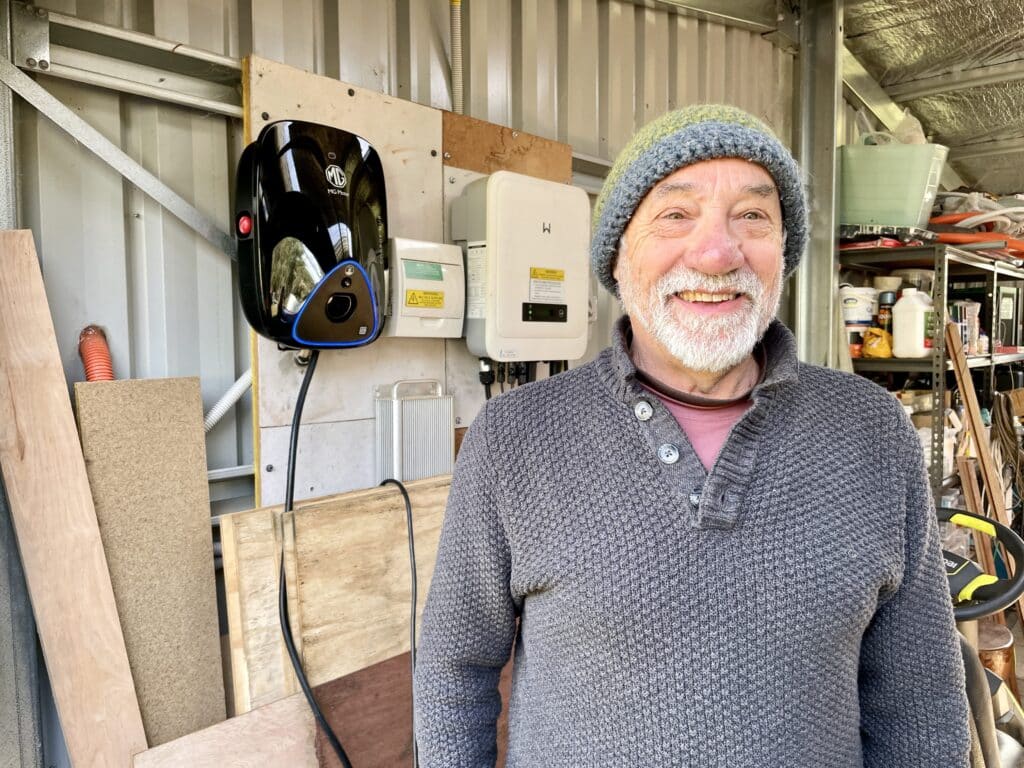
After moving to Tasmania with his partner, Tomoko, Trevor helped design their current home as a fully electric, solar-powered property with a wet-back wood system and heat pump. “We’ve gone all electric, so all of the cooking now is carbon free,” he says. “We’ve reached that point we were aiming for many years ago.”
Transportation was the next frontier. After trialling a Nissan Leaf during a stay in Japan, Trevor realised the key to electric vehicle viability was home charging. “You need a charger at home. I can’t see it working any other way,” he says. Today, they charge their car off-peak from their own solar hub. Fuel costs have dropped to about 10 per cent of what they once paid.
His passion for energy independence and sustainability has made him a supporter of Rewiring Australia. “We’re quite strong environmentalists,” he says. “But I think the key to solving those problems is that people get a financial return out of it.”
For Trevor, the value of something lies not in what it promises, but in what it delivers. “You should think about, is that thing I’m going to buy actually going to pay me back? And if it’s not gonna pay you back, do you really need it now?” he says.