Four times this year, residents of Tasmania’s Meander Valley have gathered to swap vegetables, seeds, and gardening advice. Each time, more people have shown up.
The latest event, held at Elvenhome Biodynamic Farm in Weegena, drew more than 60 people. Produce changed hands. Garden tours ran long. A two-hour event stretched to four.

The next crop swap is on Saturday, 12 July, from 10am to 12pm, at the Deloraine Community Garden. Organisers are expecting tea, a garden tour, late autumn and early winter produce, and the kind of conversation that tends to keep people well past the scheduled finish. Attendees are asked to bring their own cup, plate, cutlery, and chair, along with something to swap or share.
The events are organised by the Meander Valley branch of Permaculture Tasmania, a volunteer-run not-for-profit that has operated in the state since 2005. The organisation was close to closing in 2024 before being revived. Permaculture Tasmania now counts around 400 financial members and more than 4,000 social media followers.
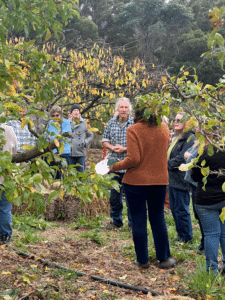
Loretta Leary, who coordinates the local group alongside her husband John Kane and Patrick Casey started the Meander Valley branch a year ago as a way of building community connections around permaculture principles. The first swap in January was small, a circle of friends and a few newcomers. By the third event, hosted by local gardener Tomoko Woods at her property, around 30 people attended and toured the gardens. The fourth at Elvenhome brought more than 60.
Leary, a former teacher, traces her interest in permaculture to a staff development day at her school, when she organised the building of a raised vegetable garden and began researching companion planting. She later learned she had been drawing on ideas formalised by Tasmanians Bill Mollison and David Holmgren, who coined the term permaculture in the 1970s to describe a system of sustainable growing and living that works with natural processes rather than against them.
Growing in the Meander Valley has its rewards and its difficulties. Garlic, tomatoes, potatoes, onions, and brassicas perform well in the region, as do apple and nut trees. But wildlife pressure is a persistent challenge. Wallabies, pademelons, possums, and cockatoos can devastate unprotected crops.
Attendees at the swaps come from across a wide area. Most are from within the Meander Valley, from Miena and Golden Valley through to Mole Creek and Elizabeth Town. Some travel from Launceston and the West Tamar.
The swap operates on a simple principle of fair exchange. Produce, seeds, seedlings, tools, and knowledge all circulate. Leary says people who arrive without anything to swap are welcome. “If we all share fairly,” she says, “then we can accommodate and support each other fairly too.”